

Natural language search: “shampoo under €10”
Customers ask the way they would ask a shop assistant. Findora understands category, price and need, and explains what it understood.
“Φέρε μου σαμπουάν κάτω από 10€” (get me shampoo under €10). “Αντηλιακά από 10 έως 20 ευρώ” (sunscreens from 10 to 20 euros). “Κάτι για την ακμή” (something for acne). More and more customers type into the search box the way they would talk to a shop assistant. A conventional search looks for products containing the word “κάτω” (under) and “10€”, and finds nothing.
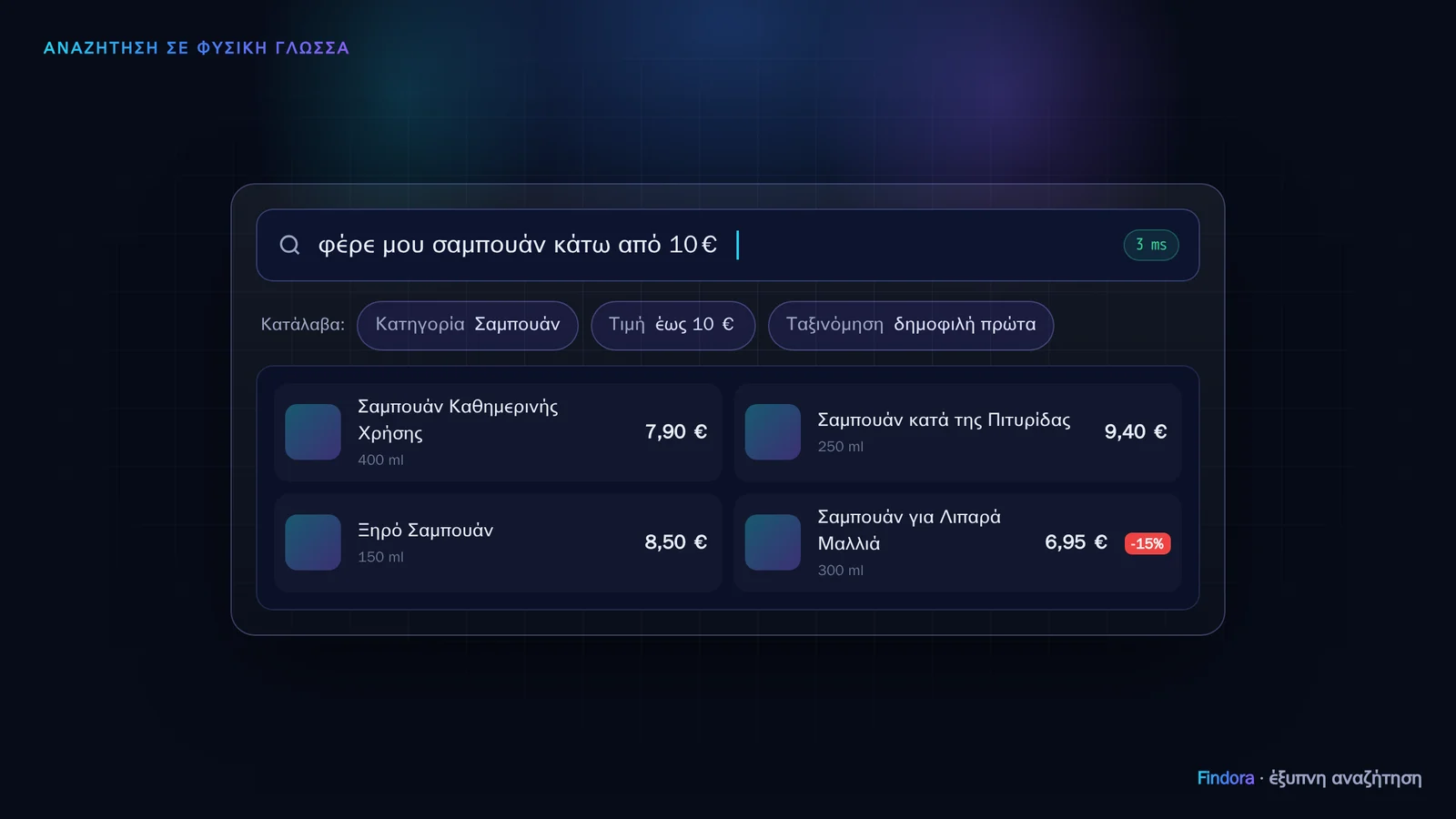 Findora recognises the category and the price range, and shows the customer what it understood.
What it recognises
- Price range: “κάτω από” (under), “έως” and “μέχρι” (up to), “από… έως…” (from… to…), “πάνω από” (over), with or without “€” or “ευρώ” (euros).
- Category: “σαμπουάν” (shampoo), “περιποίηση μαλλιών” (hair care) and “αντηλιακά” (sunscreens) are recognised as categories in your catalogue, not as plain words.
- Needs: with the “Needs” dictionary, “ακμή” (acne) brings up Effaclar, Cleanance and Sebium, and “τριχόπτωση” (hair loss) brings up anti-hair-loss products, even if the word doesn’t appear in their names.
- Filler words: phrases such as “φέρε μου” (get me), “θέλω” (I want), “έχετε” (do you have), “κάτι” (something), “προϊόντα στην κατηγορία” (products in the category) are removed, so that only the substance remains.
- Every case and number: “περιποίηση” and “περιποίησης”, “κρέμα” and “κρεμών”, “μαλλιά” and “μαλλιών” (different grammatical forms of “care”, “cream” and “hair”) are treated as the same thing.
Long questions, the way we speak
Customers don’t always type two words. They write “θέλω προϊόντα περιποίησης για ξηρά και ταλαιπωρημένα μαλλιά” (I want care products for dry, damaged hair) or “ψάχνω μια καλή κρέμα ματιών για μαύρους κύκλους” (I’m looking for a good eye cream for dark circles). Findora:
- finds the category within the sentence, even if its words are scattered (περιποίηση… μαλλιά — care… hair);
- keeps the category as a boundary, so it doesn’t bring up unrelated products;
- uses the remaining words (“ξηρά” — dry, “μαύροι κύκλοι” — dark circles) to put the best-matching products first, with the rest of the category below.
If the question contains a brand or a product code (“carmex lip balm spf15”), the customer is looking for a specific product, and the search targets it precisely.
The customer always sees what was applied
Above the results, a message shows the criteria, e.g. “Category: Shampoo · Price: up to €10”. If the system understood something different from what the customer meant, they see it immediately and correct it.
Which plan
Natural language search is included in all plans. The “Needs” dictionary is available on the Pro and Enterprise plans.
Want to see how it would work with your own catalogue? Request a demo.